Tuesday, 30 June 2015
Ssese beauty blighted by dysfunctional health system
Don’t let the tranquil, picturesque seclusion of the island district of Kalangala fool you; this home to Ssese islands, an archipelago of 84 islands, is a perfect natural beauty, but also a poster child for numerous health and system plagues associated with many far-flung districts.
Seeing Lake Victoria’s waves reluctantly touch the shores and feeling the morning chill bite one’s skin is tantalizing. However, on this particular morning, hundreds of people saunter through the serpentine roads on Bugala Island to receive free medical care courtesy of a medical camp organised by Uganda Health Marketing Group (UHMG) last week.
The stories from the locals about the challenges of accessing health services are striking.
Robina Nakato, formerly from the island of Bubeke whose toddler died earlier this year from severe malaria, blames the death on the poor quality health care on the island.
“I had earlier reported to a drug store in Bubeke and was given drugs by a ‘nurse’ since there was no doctor, but [the drugs] did not work. I cannot afford coming to Kalangala Health Centre IV all the time, because a trip costs me about Shs 40,000, which I don’t have,” the mother of two says. “My son worsened at home and a few hours after arriving at the health centre, he died.”
ACCESS DELAYS
There is no district hospital and Kalangala HC IV is the main referral health facility for the 64 habitable islands. The islanders have repeatedly highlighted the austerity of an inadequate transportation to access health facilities, leaving many of them to resort to the expensive and scarce private clinics or even traditional healers.
“That night will forever haunt us, because I wonder, had it not been for the transport delay and earlier wrong diagnosis, would my son be alive?” Nakato forlornly says.
According to Willy Lugoloobi, the Kalangala district chairman, Bubeke and Mazinga islands are the hardest to reach. It will cost a person 80 litres of fuel and four litres of oil to travel from Bubeke to Kalangala HCIV. For those from Mazinga Island, the furthest from Kalangala town council, it takes 100 litres of fuel and five litres of oil. Each litre of fuel costs Shs 5000 in these parts.
“In Kalangala, a walkable distance is talked of in terms of a swimmable distance. It is not only a hard-to-reach district but also a hard-to-stay in. About Shs 600,000 for primary health care is channelled in per quarter but even accessing that money from the bank is hard. In Mazinga, you have to use eight litres of fuel to reach the bank,” Lugoloobi says.
All the islands are served by only 15 health centres, two thirds of which are located on Bugala, Kalangala district’s biggest and administrative island. Further referrals to Entebbe hospital or Masaka regional referral hospital are facilitated by the MV Kalangala ferry that costs Shs 15,000 per head from Lutoboka to Nakiwogo in Entebbe, and MV Pearl that docks at Bukakata, respectively.
Deeply concerned for the wellbeing of their other children, Nakato and her family moved to Bugala last year.
Unlike Nakato who could afford moving nearer to the health facility, thousands remain stranded on smaller islands meaning that delays in accessing health care services is costing lives and hampering the right to health.
According to the 1995 Uganda Constitution, Objective XIV (b), the state shall ensure that all Ugandans enjoy the rights, opportunities and access to health services.
However, the realisation of this access is still a far cry for the locals in Kalangala.
According to the district’s statistics, only 17 per cent of expectant women deliver in health facilities. Sarah Subo, a health educator with the district for 15 years, says majority of the women depend on traditional birth attendants.
MORE DEPRESSION
Although health worker deployment is at 80 per cent within the district, Lugoloobi says that harsh working conditions are forcing medical workers out.
“Teachers are now forced to share their accommodation with medical workers, because medics have nowhere to sleep,” he agonised.
Moreover, HIV prevalence remains high at 25 percent which implies that 25 of every 100 people are infected.
Subo attributes the high prevalence to the falling condom use in the face of ever increasing commercial sex associated with fishing communities.
“Unprotected sex costs Shs 20,000 and above, whereas protected sex is negotiable from about Shs 5000. Having more than eight sexual partners and swapping them is also common,” Subo explains, adding that the vice is spreading to adolescents too.
The high prevalence is also brought on by drug stock outs in some months. To deal with these challenges, Prof George Kirya, a founder member of UHMG says it (UHMG) organises annual health camps in the district, bringing drugs, HIV testing, cancer screening, immunisation and health awareness closer to the locals.
However, Lugoloobi says, all the health problems cannot be met in a health camp.
“We need a district hospital and more health centres, because each of the seven sub counties is supposed to have a Health centre III. We appreciate the camp efforts but if one gets sick after, they are met with the familiar challenges,” he said.
NEW PLEDGES
Sarah Opendi, the state minister of health in charge of primary health care pledged to give the district two motorised boats to ease health workers’ movement among the islands. Their delivery is expected in August this year.
“Government is also going to give the district priority status and establish maternity wards to reduce on maternal deaths,” she told residents during the health camp.
Opendi, however, urged them to observe personal hygiene and safe practices to avoid diseases such as cholera.
At least 1000 women, men and children attended the camp.

Monday, 11 May 2015
Saturday, 14 March 2015
New cancer unit lights up patients
Each day, about 200 people report to the
Uganda Cancer Institute (UCI) in Mulago for treatment, checkups and counseling
about the devastating malignancy. Some of them travel miles from the Democratic
Republic of Congo (DRC), Burundi and Tanzania because UCI is the only national
and regional free cancer referral centre.
Outside the outpatient department, tens
of patients try to find sits, floor space and tree shades to rest and wait because
wards are full. When the sun sets, patients who cannot afford transport fare
back home saunter into the wards to sleep. Christine Namulindwa, the
institute’s publicist, says the prohibitive cost of cancer treatment in private
facilities has led many to seek free treatment at the institute. The high cost
of equipment and drugs explain the exorbitant cost of treatment.
“The cheapest cancer treatment is about
Shs 14 million and majority of the patients cannot afford it, which explains
the overcrowding here. However, we are also met with the challenge of limited
skilled personnel as there are only 12 oncologists,” Namulindwa says.
 |
| Children afflicted with cancer find rest-Photo Credit/Nicholas Bamulanzeki |
In the past few years, UCI has reported
a spike in cancer incidence, particularly infection related cancers such as Kaposi
Sarcoma, sending a wakeup call to government. Although there is no nationwide
data, estimates obtained from UCI’s registry indicate that some 300,000
Ugandans develop invasive (advanced stage) cancers and over 10,000 of these die
annually.
NEW
PREMISES
In 2011, government invested Shs 10.4
billion to construct a new, modern cancer unit. Currently, some of the wards on
this six-floor unit are up and running. For now, mainly children, patients
admitted to the private wing and those going to be operated are using the
facility. Majority of patients are still using the old block as the new block
is short of medical equipment.
 |
| The new cancer block-Photo credit/Nicholas Bamulanzeki |
Inside the children’s ward on level four,
hued caricatures painted across the walls are a fresh face to the children’s
treatment. Accordingly, these play a role in keeping the little ones in high
spirits. Six year old Jordan Kibirige from Mukono was
admitted here one week ago.
He is battling Burkitt’s lymphoma, a
potentially fatal cancer that has left him with a painful swelling on the left
side of his face. The lymphoma, associated with malaria, is known to grow
rapidly such that the tumours double their size in five days.
“So far, we have been able to get quick
treatment and bed space at this new facility. I hope my boy will soon recover,”
Kibirige’s mother forlornly says.
At least one doctor and nurses are on
duty here throughout the day, a sign of relief to the over 20 patients here.
So far the journey is comfortable; clean
toilets, lifts, regular electric power, piped water and free lunch. The
theatre, on level two, is operational and Namulindwa says it has greatly
reduced congestion at Mulago hospital’s general theatre. The building also has
a mortuary, intensive care unit, private wing and an imaging and nuclear
medicine department.
 |
| Inside the children's ward |
However, Namulindwa expresses fear that
with the swelling number of patients, this facility will soon be overwhelmed.
“The new centre is expected to
accommodate 100 patients but we’ll be seeing more than these,” she said.
The new facility will officially open
mid this year.
MORE
DEVELOPMENTS
A comprehensive state-of-the-art
research, training and outpatient cancer centre is currently in the final
stages of construction. The Hutchinson Cancer Research Institute- Uganda sits
on 25,000 square feet and will include an outpatient clinic, chemotherapy
infusion rooms, research laboratories, molecular diagnostic labs, a training
center and data centre among others.
This facility seeks to ensure the
availability of medical care, overcome the social and economic barriers to
completing treatment and improve capacity of the medical infrastructure to
diagnose and care for patients. With the new premises, it is hoped that the
five-year survival rate of cancers such as leukemia which is less than 40 per cent
will be improved.
The centre, whose construction began in
April 2013, is slated to officially open in May this year. It is supported in
part by the United States Agency for International Development, American
Schools and Hospitals Abroad Programme.
Namulindwa also told The Observer that plans are underway to
construct a Radiotherapy and Nuclear Medicine Centre.
In spite of these developments,
challenges of limited beds and equipment, medical personnel brain drain and
forbiddingly expensive drugs are rife.
“Diagnosis equipment for examining
biopsies is only available at Mulago Referral hospital and because of the
limited number of pathologists, results take up to two weeks to return,”
Margaret Okello, a volunteer counselor at UCI, notes adding that there is only
one radiotherapy machine in the entire referral hospital.
Moreover, because of the limited number
of oncology personnel, nurses have had to be trained on the job in order to
administer drugs.
Okello and Namulindwa urge government to
subsidize pharmaceutical companies that supply drugs in order to make them more
affordable and available.
“We also appeal to government to
adequately remunerate skilled personnel and invest in the purchase of modern
equipment such as a magnetic resonance imaging machine,” Namulindwa says.
This article first appeared in The Observer.
Sunday, 31 August 2014
TB drugs: poor countries hanging by the thread
Julius Kiiza, 26, was like
many youths his age a few years back. He loved to hang out and live a good
life. Never in his wildest dreams did he think he was developing a virulent
form of Tuberculosis – the multi drug resistant TB (MDR-TB).
I met him at Hoima
regional referral hospital TB ward. As he motioned towards me, it was as if his
legs would snap under the weight of his body.
Kiiza, a father of
four, was diagnosed with MDR-TB on November 28, 2013. Prior to this, Kiiza was
already grappling with HIV which was discovered in 2011.
He was to later develop
a wracking cough, characterized with chest pain.
“I would lose breath
especially at night because of chest congestion,” he said.
Kiiza was diagnosed
with TB and was started on the regular eight month drug regimen. Five months
down the road Kiiza was found to have MDR-TB.
MDR-TB
occurs when bacteria do not respond to Isoniazid and Rifampicin, the two most
powerful, first-line anti-TB drugs.
Because of Kiiza’s co-infection (HIV and TB), he swallows
at least 20 pills a day and he will be receiving an anti TB injection daily for
six months.

While identifying those with the active disease will
provide a long-term public health benefit, Moses Mulumba, a patent lawyer says
that without new, simple and affordable treatments for MDR-TB, this is impossible.
“If pharmaceuticals developed one tablet a day for
TB, this would mean reduced pill burden and greater adherence. However, such
developments for the developing world are deficient due to the lack of return
on investment opportunities for pharmaceutical companies,” says Mulumba, the
executive director of Center for Health, Human Rights and Development (CEHURD).
Most recently, Britain/Sweden pharmaceutical,
AstraZeneca announced it was pulling out of all early stages of research and
development for malaria, TB and neglected tropical diseases to instead focus on
cancer, diabetes and hypertension.
Welcome to the world of intellectual property (IP),
where giant pharmaceuticals determine drug availability and pricing.
Prices of drugs vary depending on whether the drug
is under patent – 20-year protection by the manufacturer – or generic, where
the patent has expired.
In the private sector market, the brand/patented version
of Linezolid, an MDR-TB treatment drug, costs $65 (approximately Shs 166,400) for
a daily pill. For a patient taking a pill a day for two years, this amounts to over
$49,000 (over 125m). It is produced by Pfizer, an American pharmaceutical corporation.
Generic versions of the drug, produced by Hetero,
an Indian pharmaceutical company, cost of $8 (Shs 20,000) per pill.
When asked whether he would have afforded
Linezolid had it not been provided freely, Kiiza laughed sarcastically: “I
think I would have died a long time ago because I don’t have a cent!”
Because majority of Ugandans still survive on less
than $1 (Shs 2,560) a day, Uganda receives TB drugs through aid.
The case of ARVs provides a dramatic illustration
of the global impact of Indian drug firms.
In 2001, Indian drug company Cipla, introduced
first line treatment for HIV at $ 350 (Shs 896,000) per person per year, a
stunning offer at the time.
Other Indian firms followed Cipla’s model and
today, 80 per cent of people living with HIV who are on treatment in developing
countries rely on Indian generic drugs.
TRADING
AWAY LIVES
Uganda being a member of the World Trade
Organization (WTO) is under obligation to develop rules that comply with WTO
guidelines. Among these is the Trade Related Aspects of Intellectual Property
(TRIPS) agreement requiring all members to standardize minimum standards of IP,
including patents for pharmaceuticals.
IP rights give the
creator an exclusive right over the use of his or her creations for a certain
period of time, such as 20 years, for a scientific innovation like medicine.
The pharmaceutical industry in developed countries strongly depends on
the patent system in order to recoup research and development costs.
“TRIPS sustain a regime of private monopoly rights
which impedes access to essential medicines because of prohibitive prices. It also
delays production and market entry of generics because producers will have to
wait 20 years for a patent to expire,” Mulumba explains.
Moreover, countries such as India
and Brazil where
generics are produced now grant medicines patents in order to comply with their
obligations as WTO members. New drugs are already patented in these countries
meaning that production of
affordable generics is now restricted.
Such a
restriction led Cipla to establish Quality Chemicals Limited in Uganda because
that law does not hold for LDCs.
Under
TRIPS, LDCs are supposed to enforce patents
on all medicines by 2021. Tentatively, this means the end of all generic drugs.
In
response to the TRIPS agreement, WTO delegates issued the Doha declaration on
November 14, 2001 which exempts LDCs from implementing patent law for
pharmaceuticals until January 1, 2016. This was extended to 2021 last year.
ENFORCING PATENTS IN
UGANDA
To
guarantee intellectual property rights to innovators, parliament this year
passed the Industrial Properties Act. It spells out protection for products and
processes in all fields of technology, including medicine.
Mulumba
forecasts that the law will only work if there is government commitment to
invest in research and development, develop human capacity and offer attractive
incentives such as tax holidays to innovators.
“The law integrates flexibilities such as the
bolar provision which enables researchers’ reverse-engineer drugs even when the
patent on it has not yet expired. But all the seven plants we have are not
doing research because of high production costs,” he says.
Another policy is the Anti-Counterfeit Goods law which prohibits the
manufacture, trade and release of fake goods on to the market. Contentious, however, is the fact that it
regards generics as counterfeits.
“This is
part of a global agenda to keep developing countries from importing from third parties
like India and Brazil where the cost of production is much cheaper. All these
things are happening because we are a disorganized lot. We Africans are doomed
unless we wake up!” says Edgar Tabaro, a patent lawyer with Karuhanga, Tabaro
and Associates.
SOLUTIONS TO A GLOBAL CRISIS
In
2000, the UN Security Council declared HIV a global security issue and resolved
to establish a Global Fund (GF). GF is the biggest financer for HIV and TB
programmes in Uganda, having channeled at least $ 200m over the years.
“In
October, Uganda is sending the GF another proposal for HIV/TB funding to enable
us scale up prevention and treatment efforts,” Prof Vinand Nantulya, chairman
Uganda Aids Commission said.
Uganda
is also a member of WHO’s Global
Drug Facility (GDF), the largest supplier of quality TB treatments. Nantulya
says it is through this that the country procures TB medicines and innovative
tools such as the GeneXpert at reduced prices.
“Uganda needs to develop collaborative research so
that our scientists can catch up with others in the developed world and
partnerships such as the Global Alliance for TB drug development should be more
actively supported to allow for the development of drugs that are free of
patent restriction,” Tabaro urges.
Currently, 11 TB vaccines are in clinical trials
worldwide. WHO estimates that the earliest a vaccine could be licensed is 2020.
BCG (Bacille Calmette Guerin) vaccine remains the only vaccine against TB in
general use.
This
story was supported by the African Center for Media Excellence.
Tuesday, 5 August 2014
Better TB management urgently needed
I had
heard about Tuberculosis (TB) and the wreckage it causes in a patient’s life
just in the passing, until I set out to document issues hindering drug access.
The
dismal condition of a patient I found at Bulondo Health Centre III in Wakiso district
exceeded my saddest expectations.
Fred
Musoke’s lips were chapped, dry and red, bones almost visible and his skin dark
as ebony.
He tossed
and turned, seeking comfort, coughing and spitting into his lesu.
Death,
he said, would be a reprieve.
“I
feel feverish all the time and do not have appetite. The woman that I wanted to
marry left me about two months ago because of this sickness,” he muttered from behind
a dark green mask covering his mouth and nose. He keeps the mask on to avoid spreading
the TB to others. Before I could talk to him, I was handed one too.

Before
getting TB, Musoke, 31, was a market vendor selling second hand clothes. Then
five months ago he was diagnosed with TB.
“I was admitted two weeks ago after becoming so
ill one weekend that I could not walk,” he said.
Because Musoke has HIV, he is no stranger to the
health centre. It is here that he has been getting ARVs.
However, his struggle is further complicated by
inadequate drugs at the facility.
“Many of our health facilities do not have some of
the most required drugs such as Ethambutol, Isoniazid and Rifampicin needed to
treat regular TB and also Septrin which is necessary in fighting opportunistic
infections like TB in people with HIV,” says Expedit Mwambazi, Wakiso district’s
TB focal person
The centre’s laboratory room was crawling with
spiders and wasps instead of diagnostic equipment. It has been so for over five
years according to one of the health workers.
Many health centres do not have TB units, which
has perpetuated the mixture of TB patients with other patients. The World
Health Organization (WHO) warns that people with TB can infect up to 15 other people
through close contact.
TB remains the biggest killer of
people living with HIV, causing nearly 50 per cent of deaths. Primah Kazoora, a TB survivor,
says malnutrition, living in slums and poorly ventilated houses also accelerate
the development of TB.
THE
LETHAL ANNIHILATOR
Tuberculosis
is one of the deadliest and most disabling diseases. It is an airborne disease caused by a type of
bacterium; mycobacterium tuberculosis, transmitted by being in proximity to
coughing, talking or sneezing patients.
If not treated promptly and
consistently, says Dr Alphonse Okwera the head of Mulago hospital’s
TB treatment centre, it weakens the patient, damages the lungs and may spread
throughout the body.
In
its advanced stages, the sputum comes with blood.
 |
| TB affected lungs/Photo-Courtesy |
TB kills some 4,700 Ugandans
every year.
In its 2013 report, WHO noted
that of the 8.6 million people that fell ill with TB in 2012, 1.3 million died.
At least 95 per cent of these deaths were recorded in middle and low income
countries such as Uganda, Ethiopia and Swaziland.
“In 2012, an estimated 530,000 children became ill with TB and 74,000
HIV-negative children died of TB. At any given moment, 12 million people
globally are suffering from an active infection,” reads the report.
TB
kills someone approximately every 25 seconds and an estimated nine million new
cases develop each year.
The WHO
report ranks Uganda 18th out of 22 high-burden countries that account for 80
percent of new TB infections worldwide. According to Ministry of Health and the National TB and Leprosy
Programme (NTLP), there were approximately 49,000 new TB cases in Uganda in
2011.
“The high burden of the TB disease is mainly in the urban and peri-urban
centres, with Kampala accounting for 7,800 cases, Wakiso 1,300 cases and other
regional towns account for between 1,300 – 1,600 cases each,” says Dorothy
Namutamba, the program officer at the International Community of Women Living
with HIV/Aids, Eastern Africa (ICWEA).
Although its burden is spread across all age
groups, TB exacts its greatest toll on individuals during their most productive years, from ages 15 to
44.
CHALLENGES
IN THE TB COMBAT
Uganda in 2000 pledged, as part of the Millennium Development Goals (MDGs), to halve TB prevalence and deaths by 2015. But despite setting
up over 1,200 diagnostic centers nationwide it is still far from these goals.
Namutamba
says one of the major setbacks is lack of priority and
limited information about TB in
communities.
“Unlike
HIV which has gained ground through community sensitizations and literacy
programmes implemented by government and the civil society efforts, TB has been
left to the laboratories and the health care providers,” she says.
In an
assessment study by ICWEA on the availability and accessibility of TB/HIV
services in Kampala, Wakiso, Mityana and Mubende districts between 2010 and
2012, majority of the interviewees showed low knowledge on TB .
“When
a person develops active TB, the symptoms including cough, fever, night sweats,
weight loss and blood stained sputum, may be mild for many months. This may
lead to delays in seeking care,” says Dr Okwera.
Another challenge is the long duration of
treatment, lasting at least eight months.
RISE OF A SUPERBUG

Because of the seemingly long duration, many
patients abandon the drugs.
“Only
78 per cent of those with the disease undergo successful treatment and the
other fraction are those that die, fail on treatment and those for whom follow
up is lost,” says Dr Frank Mugabe, the acting program manager, NTLP.
Lack
of drug adherence has urshered in new drug resistant forms of the bacterium,
spreading a new phenomenon of Multi Drug Resistant TB (MDR-TB).
MDR-TB
is a form of TB caused by bacteria that do not respond to, at least, Isoniazid
and Rifampicin, the two most powerful, first-line anti-TB drugs.
Currently,
the two year drug regimen for MDR-TB costs $3,000 compared to $10 to treat
regular TB.
“[Comprising] about 20
pills a day and painful injections for six months, MDR-TB treatment is
difficult to adhere to. Even if patients adhere, half are likely to die from
this type of TB,” says Dennis Kibira, a
pharmacist and deputy director of the Coalition for Health Promotion and Social
Development (HEPS-Uganda).
In a move to nip resistance in the bud, Dr Mugabe says
the country has improved its ability to test for drug-resistant TB by
introducing the GeneXpert, a rapid testing machine that can diagnose TB in
sputum samples in less than two hours.
 |
| GeneXpert machine/Photo-Courtesy |
Nevertheless, there are only 14 treatment sites in
the country. The ICWEA survey notes that Mubende hospital at the end of March 2013, had five
patients who had been confirmed with MDR TB but sent them home because of the
hospital did not have drugs to treat them.
“We
need a shorter treatment option to transform TB treatment from an agonizing ordeal, to a
shorter, more tolerable, more effective and more affordable treatment course,”
urges Kibira.
In our
second part, we shall examine how patent rights are prohibiting access to new
drugs and diagnostic technology in Uganda.
This story was supported by the
African Centre for Media Excellence.
Saturday, 19 July 2014
Kiyingi cheats death with son’s liver
Staying active and engaging in sports has been
Fredrick Kiyingi’s lifestyle since childhood.
However, as he grew older, his daily life was
affected so much that by 30, he could not partake in any physical activity.
He was 37 years old when a medical examination by
Prof Michael Kawooya, a senior radiologist at Mengo hospital revealed that his
gall bladder was releasing toxins into the liver. It was also on the verge of
rupturing.
Kiyingi, now 47, was born with a liver problem
medically termed as choledochal cyst.
Dr David Ndawula, the medical director of Kampala
Family Clinic says a choledochal cyst occurs when the bile duct, a vessel that
leads bile to the intestines from the liver, is structured abnormally.
“This causes bile to accumulate in the duct resulting
in duct damage and formation of a cyst (fluid-filled sac),” Dr Ndawula
explains.
He says that a liver transplant becomes necessary
when the liver has been damaged to the extent that it cannot perform its normal
functions. This is known as liver failure.
The liver is one of the largest organs in the
body. It produces bile necessary in digestion of fats, makes agents needed for
blood clotting, removes toxins from the blood stream and controls blood sugars,
among other functions.
“Although liver failure can be managed by
medication, this can sustain one in good health for a short while. A liver
transplant is the only cure for liver failure,” he says.

RUNNING
OUT OF STEAM
In 2001, an acute pain on the right side of his
abdomen became a bedfellow. It caused him severe loss of appetite and nausea.
“To keep the pain at bay, I devotedly relied on
drugs meant to cure peptic ulcers because doctors suspected I was suffering
from these,” said Kiyingi, the safety and security coordinator of US Peace
Corps - Uganda.
He used the drugs between 2002 and 2005.
But by May 2005, Kiyingi was starting to feel much
more tired. His body darkened and thinned so much that he suspected HIV.
“Once, I went to Kampala family clinic in Nsambya
to buy pain killers and told Dr Ndawula that I had HIV. He told me to open my
mouth and stick my tongue out and hinted on the possibility of a gall bladder
and liver complication,” the soft spoken father of two said.
He was referred to Prof Kawooya who treated him
immediately, noticing that the gall bladder was about to rupture.
Ruptures are most
commonly caused by an inflammation of the gallbladder. The most common causes
are gall stones. The initial symptom of a gallbladder rupture is a sudden onset
of sharp or severe pain.
Kiyingi was later
admitted at Case Clinic.
“I stayed at Case for
three months and while here, I had jaundice, fever, more pain and my skin got
darker,” he recalls.
Ndawula says jaundice
is caused by the liver’s failure to remove bilirubin, a brownish yellow
substance found in bile.
Kiyingi was operated
upon and his gall bladder, plagued with gall stones was removed together with a
fraction of the affected liver.
Dr Ndawula says a
portion of a liver can be removed because of the liver’s unique ability to
regenerate. It is the only organ in the body with this capability.
WORSE BECOMES WORST
Just two weeks after
the first operation, his stomach started swelling tremendously because the improvised
plastic bile duct was misdirected.
“Immediately, I was
rushed to Mengo hospital in an ambulance and about three litres of dark green
bile were drained from my body,” he reminisces.
A metallic tube was
inserted into his body to drain the excess bile and liver function tests showed
that his liver had completely deteriorated. He was thus linked to Prof Godfrey
Lule, a consultant physician and gastroenterologist at Nairobi hospital.
To raise money needed
for treatment in Nairobi, Kiyingi sold all his six cars and ended a transaction
meant to purchase a house.
At Nairobi hospital, a
magnetic resonance imaging (MRI) test revealed that Kiyingi’s liver was
completely rotten. He was now referred to Apollo hospital in India for further
treatment.
He arrived at the
hospital on December 24, 2013 and examinations revealed that he had liver
cirrhosis –an abnormal liver condition in which there is
irreversible scarring of the liver.
“The doctors here told me that I had only six
months to live unless I underwent a transplant for which I needed $60,000 and a
donor,” he says.
Fortunately his son, Laurin
Baalu, 18, was willing to part
with a portion of his liver.
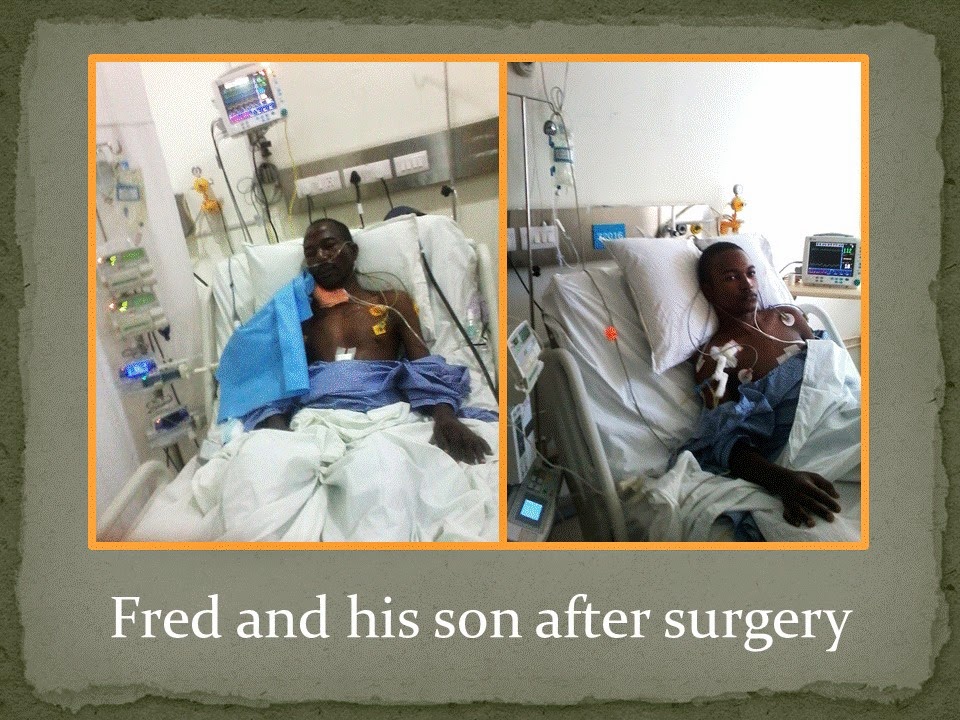
THE
FINAL STRAW
He was operated upon on March 12 at the Health Care Global Enterprises in
Bangalore-India. He remained in the intensive care unit for two weeks and was
discharged on April 17.
Although Kiyingi has been down the hatches, he is one
of the few lucky ones; he is on the road to recovery. His chocolate skin complexion
is back and he has resumed work.

However, he is now on life medication and needs $
16,385 (about Shs 42m) to clear HCG’s hospital bill
For contribution, Kiyingi can be reached on
0776578667 or direct account deposits may be made to A/C no. 1100035091-Housing
Finance Bank or 6004149376-Barclays Bank.
Monday, 14 July 2014
Parents launch appeal to save 7-year-old Maria
Unlike
many children her age, Maria Achola is not having a joyful, playful life.
Seven-year-old
Achola is confined to a hospital bed, tubes and wires running across her weak,
painful body.
For
more than two months, Achola, a pupil of St Ponsiano Ngondwe primary school in
Bweyogerere, has been battling acute hepatic encephalopathy. It is a
debilitating condition in which the liver cannot remove toxic substances from the
blood. This results in a buildup of toxins in the blood stream, which may cause
brain damage.
According
to medical records from International Hospital Kampala (IHK), where was
admitted by the weekend, Achola first presented at the hospital on May 2, with
two-week abdominal pain, yellow eyes for one day and a high-grade fever.
 |
| Achola at IHK |
In
hospital, Achola, the last born of six, continued to have high-grade fevers and
profuse vomiting, all supported with intravenous maintenance fluids and
antiemetics-drugs effective against nausea and vomiting. She was later
discharged and followed up as an outpatient. But her condition worsened, and
she was readmitted after three weeks.
A
gastroenterologist, consulted from Nairobi, guided her care and provided
contacts for a liver centre in India.
According
to Dr Sarah Bonita Musoke, a pediatrician at IHK, in children such as Maria,
the Hepatitis A virus (HAV) is associated with hepatic failure and may result
in death if left untreated.
“Achola
was not immunized against Hepatitis A. Her liver is inflamed and she is
experiencing brain impairment,” says Dr Musoke, adding that Achola needs urgent
treatment.
HAV
is transmitted mainly through eating contaminated food or through blood
transfusion.
Dr
Musoke adds that in Achola’s case, the onset of encephalopathy requires that
she gets a liver transplant.
Achola
is currently at stage two of the disease, characterized by drowsiness, gross
mental impaireness, slowed response, sullenness and disorientation from time to
time. HE has four stages and at stage four, a person goes into coma.
“We
have consulted Indraprastha Apollo Hospital in New Dehli, India who have
recommended that she be transferred to their centre for a transplant,” Dr
Musoke says.
Achola
is now in IHK’s high dependency unit (HDU), with persistent coagulopathy
(clotting and bleeding disorder) and a deteriorating sensorium complicated with
bacterial sepsis.
The
transplant package, which includes surgeries of both the donor and recipient (including
21-day stay of the recipient and 10-day stay for the donor), consumables and
bed cost, is valued at $35,000 (about Shs 90m). A pre-transplant evaluation is
estimated at $3000 (about Shs 7.6m), while travel and meals are estimated at
$12,000 (about Shs 30m).
Achola’s
parents are appealing to the public for donations to help save her life. Her
father, Vincent Adoko, may be reached on 0772516035 and A/C no:
2520512181-Centenary Bank, Namirembe Road branch.
Subscribe to:
Posts (Atom)